

Choosing the right moment for a journey into the wild is often the difference between a good trip and a life-changing one. After years of guiding through the dust of the dry season and the vibrant bursts of the rains, our team at Tanzania Safari Experience has come to a consensus: January is the best-kept secret of the safari world. While many travelers wait for the peak crowds of July, those in the know are currently watching the southern plains of the Serengeti turn into a vast, emerald nursery.
Is January a Good Time for a Tanzania Safari?
January is an exceptional time for a Tanzania safari, offering lush green landscapes, the beginning of the Great Migration calving season, fewer crowds than the dry season, and superb birdwatching opportunities.
If you enjoy the feeling of having a vast horizon all to yourself, January is your month. We call this the “Green Season,” but don’t let the name fool you into thinking it’s a wash-out. The “short rains” of November and December have usually tapered off into sunny days with occasional, dramatic afternoon thunderstorms. These storms clear the air of dust, making for the most crisp, high-definition photography you will ever experience in East Africa.
The Local Advantage: Why We Love January
-
The “Emerald” Backdrop: The dust is gone. The grass is short and vibrant. Your photos will pop with a saturation that the dry season simply cannot provide.
-
Value for Money: While not quite “low season” prices, many luxury lodges offer better availability and slightly reduced rates compared to the mid-year rush.
-
Intimacy: You won’t find 20 vehicles crowded around a single lion. In January, we often spend an hour with a pride without seeing another soul.
Which Safari is Best in January?
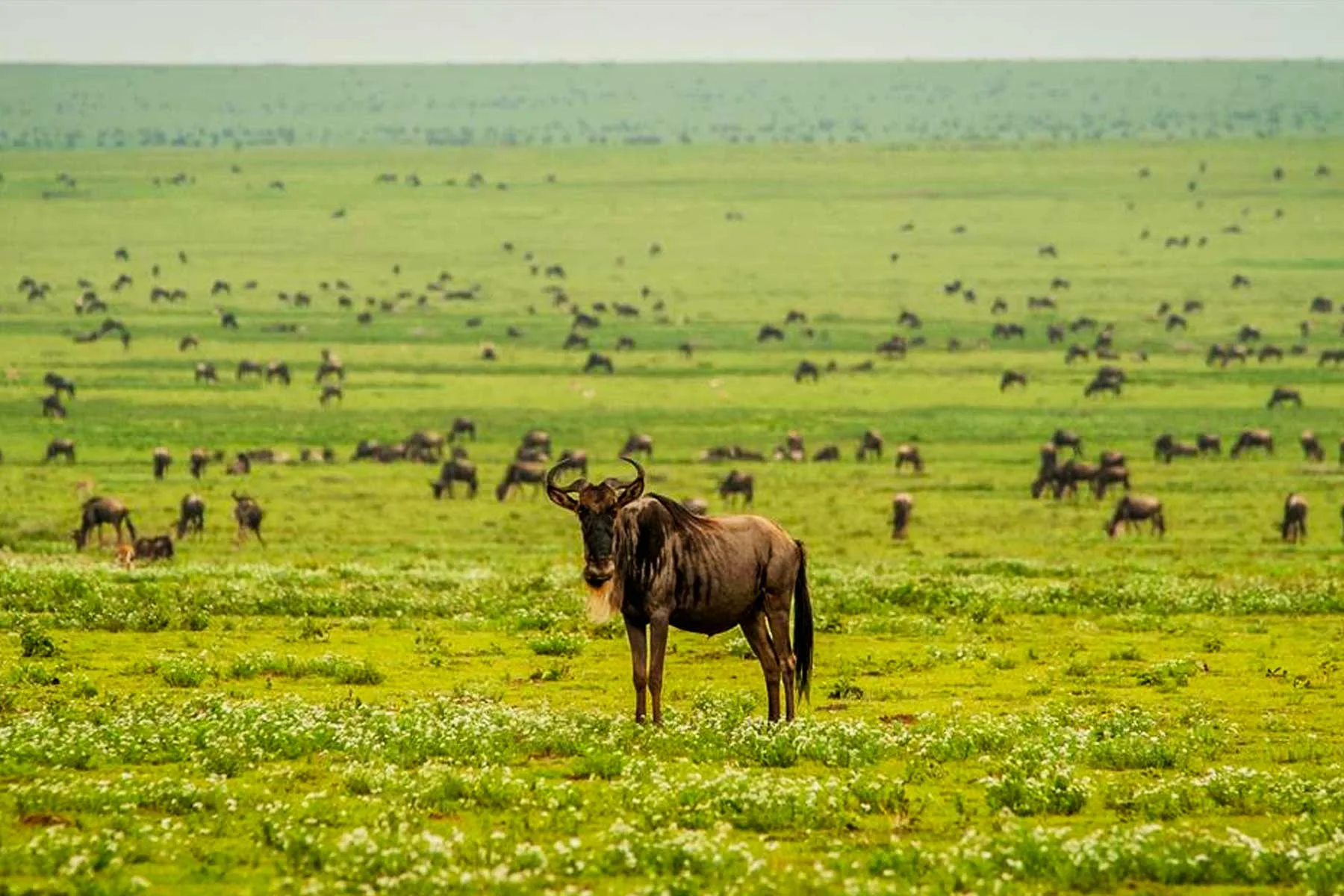
The Southern Safari Circuit, specifically the Ndutu region and Southern Serengeti, is the best choice in January to witness the Great Migration herds gathering for the massive annual calving event.
When travelers ask us where to go, we point them straight toward the border of the Ngorongoro Conservation Area and the Southern Serengeti. This area, known as Ndutu, becomes the epicenter of the natural world in January. Unlike the northern river crossings where the herds are moving rapidly, in January they settle. They are here for the nutrient-rich grass, high in calcium and phosphorus, which is essential for the nursing mothers.
January Safari Destinations Compared
| Destination | Why Visit in January | Wildlife High Point |
| Ndutu / South Serengeti | The Migration Hub | Calving begins; high predator action. |
| Ngorongoro Crater | Year-round “Eden” | The Big Five are always resident here. |
| Tarangire | Elephant Paradise | Massive herds and stunning baobab scenery. |
| Lake Manyara | Birding & Primates | Thousands of flamingos and migratory birds. |
Pro-Tip from our Lead Guide: While everyone focuses on the Serengeti, don’t skip the Ngorongoro Crater in January. Because the grass is short and green, spotting the endangered Black Rhino against the emerald floor is significantly easier than in the tall, yellow grass of August.
What Animals are in Tanzania in January?
Tanzania in January features the “Big Five,” hundreds of thousands of wildebeest calves, and a high concentration of predators like cheetahs and lions active on the open short-grass plains.
This is the season of “New Beginnings.” While the official peak of calving is usually February, by mid-to-late January, the plains are already dotted with thousands of wobbly-legged wildebeest and zebra foals. This “baby boom” triggers a massive response from the Serengeti’s apex predators.
-
Cheetahs: The short grass of the southern plains is the preferred hunting ground for cheetahs. We frequently spot them on top of termite mounds, scanning for an easy meal.
-
Lions and Hyenas: With so many vulnerable calves around, the predator-prey drama is at its most intense. You are highly likely to witness a hunt during this window.
-
The Rare Birds: January is a dream for birders. Migratory species from Europe and North Africa are in residence. Look out for the vivid Eurasian Roller or the elegant Lesser Kestrel.
RELATED ARTICLE: Highly Recommend for the Best Tanzania Safari Tours
What is the Best Month to Do a Safari in Tanzania?
The best month depends on your goals: January to March is best for the calving season, while June to October is ideal for the Great Migration river crossings.
If you are a photographer or someone who prefers the “Circle of Life” drama of the calving season, January is arguably the best month of the year. The air is clear, the landscapes are beautiful, and the wildlife is concentrated. However, if your heart is set on seeing a million wildebeest plunge into the Mara River, you should aim for August.
Wait, what about the weather?
Many people fear the rain. In our experience, January rain is “safari-friendly.” It usually falls in short, heavy bursts in the late afternoon, leaving the mornings perfect for game drives.
Seasonal Planning Guide
-
January – March: Best for Calving and Predators (Southern Serengeti).
-
April – May: The “Long Rains” (Great for budget travelers, very lush).
-
June – October: The “Dry Season” (Best for River Crossings and general sightings).
-
November – December: The “Short Rains” (Greenery returns, great birding).
Your January Safari Packing List: Expert Insights
Packing for January requires a bit more nuance than the dry season. You need to be prepared for heat, but also for the dampness of the “Green Season.”
-
The “Mud-Proof” Shoe: Don’t just bring heavy hiking boots. Bring a pair of sturdy, waterproof trail runners. The ground can get “tacky” after a rain.
-
Lightweight Rain Shell: A heavy coat is too much. A high-quality, breathable windbreaker/rain jacket is essential.
-
Neutral Layers: Temperatures fluctuate. It’s chilly at 6:00 AM on the Ngorongoro Crater rim ($14^{\circ}C$) but can hit $28^{\circ}C$ by noon in the Serengeti.
-
High-End Binoculars: Because the grass is lush, sometimes animals are tucked away. A pair of $8\times42$ binoculars will make a world of difference.
RELATED ARTICLE: Tanzania Safari Itineraries for 7–10 Days
Recommended Itinerary Strategy
To make the most of January, we recommend a 7-to-10-day “Northern Circuit” route that prioritizes the South.
-
Day 1-2: Arusha & Tarangire (Elephant herds and giant Baobabs).
-
Day 3: Lake Manyara (Flamingos and the Great Rift Valley wall).
-
Day 4-6: Ndutu & Southern Serengeti (The heart of the calving action).
-
Day 7: Ngorongoro Crater (A final hunt for the Black Rhino).
For more details on specific routes, check out our guide to the Best Serengeti Safari Routes or explore the Official TANAPA National Park Guidelines for the latest conservation updates.
People Also Ask (FAQ)
Is January too hot for a safari in Tanzania?
It is warm but rarely “too hot.” Daytime averages are around $27^{\circ}C$ ($80^{\circ}F$). The humidity is slightly higher than in July, but the afternoon breezes across the plains keep it comfortable.
Can I see the Great Migration in January?
Yes, but you won’t see them moving in a long line. In January, the herds are stationary on the southern plains for the calving season. This is the best time to see the sheer density of the million-strong herd.
Are there many mosquitoes in January?
Since it is the green season, there are more mosquitoes than in the peak dry season. However, all reputable lodges provide mosquito nets, and as long as you use repellent in the evenings, it is rarely a major issue.
Is Zanzibar good in January?
January is actually one of the best months for Zanzibar! It’s the “short dry season” on the islands, offering clear turquoise waters and perfect beach weather—making it the ideal post-safari wind-down.
Should I book a private or group safari in January?
In January, we always recommend a private safari. Because the animals are dispersed across the green plains, a private guide can spend more time tracking specific sightings without the pressure of a group schedule.
The Final Verdict
January in Tanzania isn’t just a “good” time to visit; for many of us who live and breathe the bush, it is the preferred time. You get to witness the vulnerability and triumph of new life, the raw power of predators at their most active, and a landscape that looks like a painting come to life.
By choosing Tanzania Safari Experience, you aren’t just booking a seat in a car; you’re gaining access to guides who know which hidden tracks in Ndutu stay dry after a rain and where the cheetah mothers like to hide their cubs. We ensure your trip is authentic, unhurried, and perfectly timed to catch the magic of the emerald plains.