


Is Tanzania or Kenya better for safari?
Choosing between Tanzania and Kenya is the “Great Debate” of East African travel. Both offer the iconic golden savannahs and the “Big Five,” but the ground reality of your daily experience—from the height of the grass to the number of Land Cruisers at a lion sighting—differs more than you might expect.
At Tanzania Safari Experience, we live and breathe these plains. Our team has spent decades navigating the seasonal shifts of the Serengeti and the Mara, and we’ve learned that the “better” destination isn’t about which country has more animals, but rather which rhythm of travel matches your soul.
RELATED ARTICLE: What Is the Best Safari Tour Company?
The Great Migration: Timing Your Encounter
Tanzania is better for the Great Migration if you want to see the full life cycle, including calving (January–March), while Kenya is ideal for concentrated river crossings during a narrow window (August–October).
While many travelers think the Migration is a single event, it is actually a year-round circular journey. Because the Serengeti is nearly ten times the size of the Masai Mara, the herds spend roughly nine to ten months of the year in Tanzania.
The 2026 Migration Calendar
| Month | Location | Event |
| Jan – March | Southern Serengeti (Ndutu) | Calving Season: 8,000 calves born daily; high predator action. |
| April – May | Central Serengeti | The “Green Season”: Lush grass, fewer tourists, and migrating columns. |
| June – July | Western Corridor | Grumeti River crossings; a hidden gem with fewer crowds. |
| Aug – Oct | Northern Serengeti / Masai Mara | Mara River Crossings: High-drama “survival of the fittest” moments. |
| Nov – Dec | Returning South | The herds move back through the eastern Serengeti. |
Pro-Tip from the Field: If you are visiting in February, head to the Ndutu plains on the border of the Ngorongoro Conservation Area. Most guides stick to the main tracks, but our team knows the alkaline lake edges where cheetahs use the slight elevation to hunt newborn Thompson’s gazelles.
Wildlife Density vs. Wilderness Immersion
Kenya offers high wildlife density in smaller, accessible parks, whereas Tanzania provides a sense of vast, untouched wilderness where you can drive for hours without seeing another soul.
If your goal is to “check off” the Big Five in 48 hours, Kenya’s Masai Mara is incredibly efficient. The animals are habituated to vehicles, and the smaller reserve size means less driving between sightings.
However, if you crave the “Out of Africa” feeling of endless horizons, Tanzania wins. In the Serengeti, we often find ourselves completely alone with a pride of lions. This exclusivity is harder to find in Kenya’s public reserves, where “radio-calling” can lead to twenty vehicles surrounding a single leopard.
Park Comparison: Serengeti vs. Masai Mara
-
Serengeti (Tanzania): 14,750 sq km. Known for its scale and the sheer variety of biomes (from the rocky kopjes to the riverine forests).
-
Masai Mara (Kenya): 1,510 sq km. Known for its accessibility and high concentration of big cats in a compact area.
Beyond the Big Five: Unique Landscapes
Tanzania is home to the world’s largest intact volcanic caldera (Ngorongoro) and the highest peak in Africa (Kilimanjaro), offering more geographical diversity than Kenya’s predominantly savannah-based circuit.
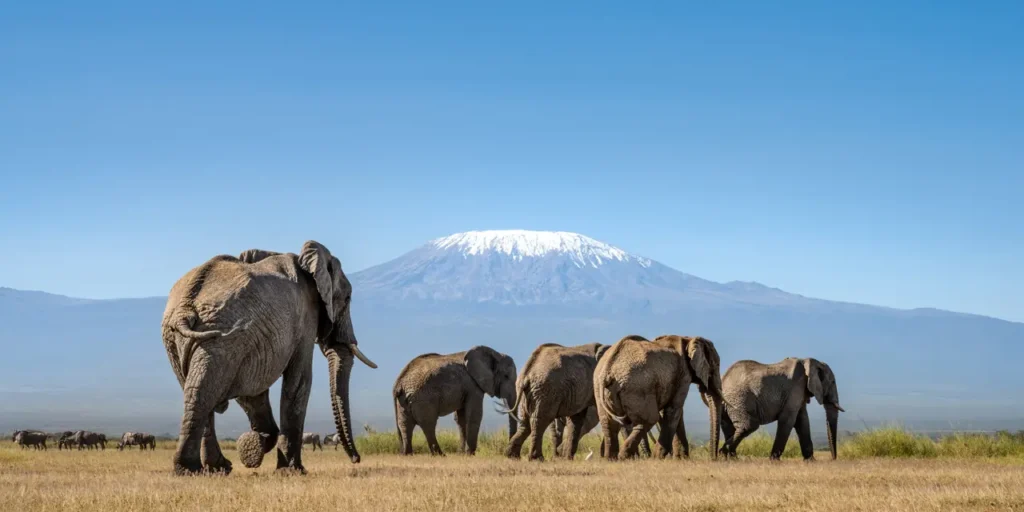
Kenya has the stunning Amboseli, famous for its elephants framed by the backdrop of Kilimanjaro. Ironically, while the mountain is in Tanzania, the best “postcard view” is from the Kenyan side.
Tanzania, however, counters with the Ngorongoro Crater. This is a self-contained Garden of Eden. Because the walls are 600 meters high, the 30,000 animals inside rarely leave. It is the most reliable place in East Africa to see the highly endangered Black Rhino.
Luxury vs. Adventure: What’s the Vibe?
| Feature | Tanzania | Kenya |
| Vehicle Style | Mostly closed 4×4 Land Cruisers with pop-up roofs (better for long distances). | Mixture of open-sided Land Cruisers and safari minivans (more common in budget tiers). |
| Crowd Levels | Lower; vehicle limits are strictly enforced in many camps. | Higher in public reserves; lower in private conservancies. |
| Cultural Touch | Authentic Hadzabe (hunter-gatherer) and Maasai encounters. | Highly developed Maasai cultural tourism (more “staged” but very accessible). |
Budget and Logistics: What Will It Cost?
Kenya is generally more budget-friendly due to its competitive flight hubs and shorter driving distances, while Tanzania is a premium destination with higher park fees and longer logistics.
As of 2026, Tanzania has maintained its “low volume, high value” tourism model. Park entry fees for the Serengeti and Ngorongoro are significantly higher than Kenya’s average.
Wait! Don’t let the price tag fool you. Because Tanzania is larger, we often recommend “Fly-in Safaris” to save time. Flying from Arusha directly into a bush airstrip in the Serengeti adds to the cost but triples your actual wildlife viewing time.
Our Recommendation for 2026: If you have 5 days, go to Kenya. If you have 8–12 days, choose Tanzania. The “Northern Circuit” (Tarangire, Lake Manyara, Ngorongoro, and Serengeti) requires time to appreciate.
People Also Ask (FAQ)
Which country is safer for tourists?
Both Tanzania and Kenya are very safe for safari-goers. Most safaris are “bubble” experiences where you are with a guide from arrival to departure. Tanzania is often cited for its political stability and peaceful atmosphere.
Can I see the Big Five in both?
Yes. Both countries host lion, leopard, elephant, buffalo, and rhino. However, the rhino is much easier to spot in Tanzania’s Ngorongoro Crater or Kenya’s Ol Pejeta Conservancy than in the open Serengeti.
Is it easy to combine both countries?
It is possible, but we generally advise against it for trips under 14 days. Crossing the land border (usually at Isebania/Namanga) involves changing vehicles and guides, which can eat up a full day of your vacation.
When is the “Green Season” and is it worth it?
The Green Season (April–May) brings rain, but it also brings the lowest prices and no crowds. For photographers, the air is dust-free and the emerald-green grass makes for stunning contrast against wildlife.
Do I need a visa for both?
Yes, most nationalities require a visa for both. Tanzania offers a straightforward E-Visa system, while Kenya has transitioned to an Electronic Travel Authorization (eTA) system. Always apply at least three weeks before travel.
Final Verdict: Why Tanzania Safari Experience?
While Kenya offers a fantastic “Intro to Africa,” Tanzania is where the heart of the wilderness truly beats. From the prehistoric echoes of the Ngorongoro Crater to the silent, golden waves of the Serengeti, it is a destination that demands you slow down and look deeper.
At Tanzania Safari Experience, we don’t just show you the animals; we interpret the ecosystem. Our guides are trained to find the “hidden” migration—the river crossings that haven’t been swamped by other tourists—and to ensure your footprint supports local conservation and community health.
