

Is Kenya or Tanzania better for Great Migration?
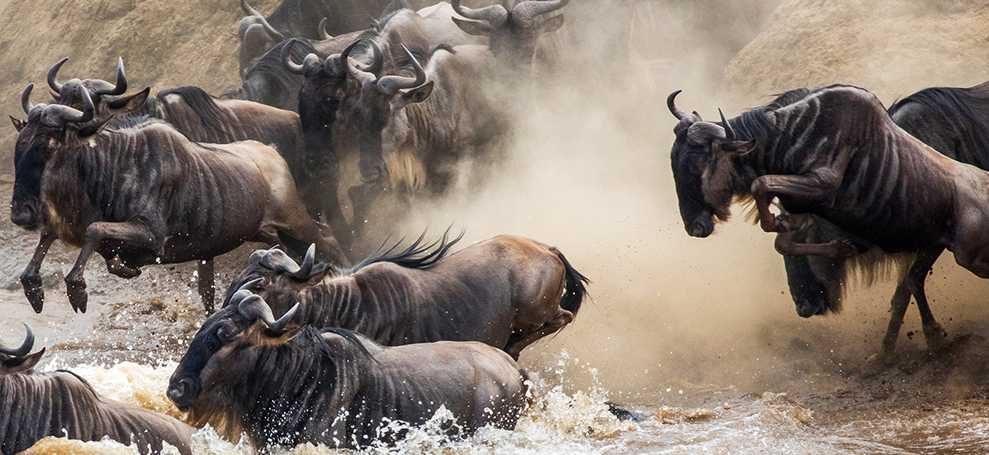
The Great Migration is not just an event; it is a 1,200-mile loop of survival that never stops. At Tanzania Safari Experience, we live and breathe these plains, and we know that choosing between Kenya and Tanzania isn’t about which is “better”—it’s about which stage of the rhythmic “Greatest Show on Earth” aligns with your calendar 2026.
While most guides give you a generic “July for Kenya, February for Tanzania” answer, the reality of 2026 travel is more nuanced. From the vehicle design differences to the secret “Grumeti Gap,” here is the expert breakdown of how these two icons compare.
RELATED ARTICLE: Your First Time Safari to Tanzania
The 30-Second Verdict: Kenya or Tanzania?
Tanzania is better for travelers seeking the full 10-month migration cycle, including the February calving season and vast, uncrowded landscapes. Kenya is superior for short, high-density river crossing safaris between July and September.
The Core Differences: Landscape and Scale
The first thing our team tells guests is to look at a map. The Serengeti is nearly 10 times larger than the Maasai Mara. This scale dictates your entire daily rhythm. In the Serengeti, you are chasing a horizon that never ends; in the Mara, you are exploring a concentrated “theater” of wildlife.
-
Tanzania (Serengeti): 14,763 square kilometers. It offers “Information Gain” through sheer variety—from the granite kopjes of the center to the acacia woodlands of the Western Corridor.
-
Kenya (Maasai Mara): 1,510 square kilometers. Its smaller size means the predator-to-prey ratio feels much higher. You don’t “search” for a lion in the Mara; you simply wait for one to appear.
Comparison: Serengeti vs. Maasai Mara at a Glance
| Feature | Tanzania (Serengeti) | Kenya (Maasai Mara) |
| Best Month | January – March (Calving) | August – September (Crossings) |
| Park Size | ~14,750 $km^2$ | ~1,510 $km^2$ |
| Vehicle Style | Closed 4×4 with Pop-up Roof | Open-sided 4×4 (Conservancies) |
| Crowd Levels | Lower (due to vast space) | High (concentrated at rivers) |
| Cost Range | Premium (High Park/Concession Fees) | Mid-Range to Luxury |
The Calving Season: Tanzania’s Exclusive Spectacle
The calving season takes place from late January to March in the southern Serengeti and Ndutu plains, where 500,000 wildebeest are born, attracting the world’s highest concentration of big cats.
If you want to see a cheetah at full sprint or a pride of lions teaching cubs to hunt, Tanzania in February is peerless. I often tell my guests that while river crossings are dramatic, the calving season is emotional. You will see thousands of wobbling newborns taking their first steps, only to be tested by the circling predators of the Ndutu plains.
Pro-Tip: Don’t just book “The Serengeti.” Ask for Ndutu. It technically sits between the Ngorongoro Conservation Area and the Serengeti, and it’s the only place where off-road driving is permitted during the migration, allowing us to get you within meters of the action.
The River Crossings: Drama on Two Fronts
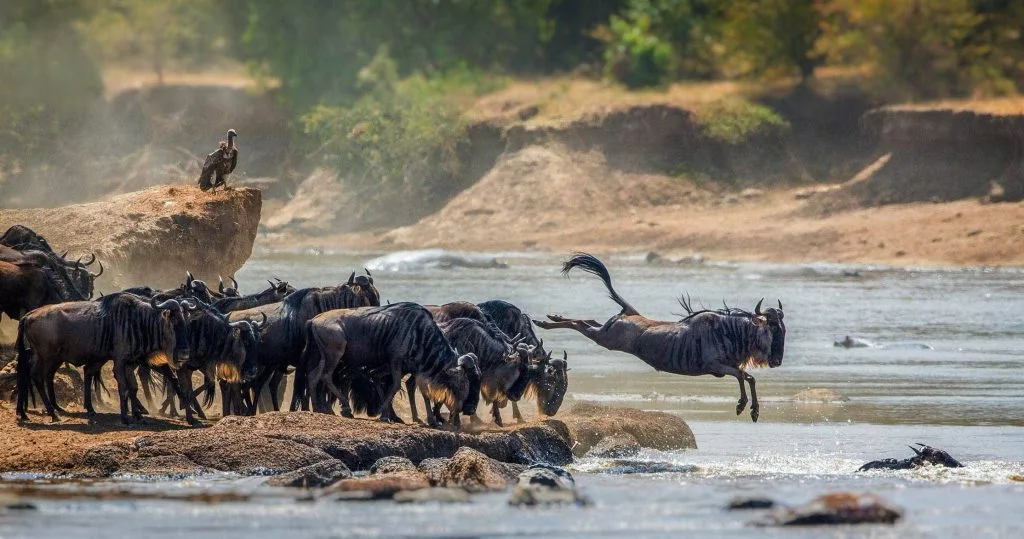
River crossings occur between July and October as herds brave the crocodile-infested waters of the Mara and Grumeti rivers, with sightings possible in both northern Tanzania and southern Kenya.
Many travelers assume the “crossing” only happens in Kenya. This is a common misconception. The Mara River actually zig-zags across the border. In fact, some of the most dramatic, steep-banked crossings happen on the Tanzanian side (Kogatende).
-
Kenya’s Advantage: The river loops are tighter, making it easier for guides to predict where a crossing might happen.
-
Tanzania’s Advantage: The Kogatende region is much harder to reach, which means you’ll share that “National Geographic” moment with five vehicles instead of fifty.
Logistics: The “Vehicle Gap” No One Mentions
One of the biggest differences our team notices is the gear. In Tanzania, government regulations mean almost all vehicles are closed-sided with pop-up roofs to handle the long, dusty highway transfers between parks.
In Kenya, particularly in the private conservancies, you often use completely open-sided vehicles. For photographers, this is a game-changer.
Expert Note: If you are a professional photographer looking for “eye-level” shots of a leopard, Kenya’s open vehicles offer a slight edge. However, if you want the “all-in-one” experience of the Ngorongoro Crater and the Serengeti, Tanzania’s sturdy 4x4s are the gold standard for comfort.
The Hidden Season: The Western Corridor (June – July)
The Western Corridor is Tanzania’s “secret season” in June and July, featuring the Grumeti River crossings where giant crocodiles lie in wait for the migrating herds.
While the world waits for August to visit Kenya, our team at Tanzania Safari Experience often recommends the Grumeti region. It’s wilder, grittier, and far less crowded. The Grumeti River isn’t as wide as the Mara, but the crocodiles here are legendary for their size.
Budget Comparison: Which Costs More?
A Tanzania safari typically costs 20% to 30% more than a Kenya safari due to higher government park fees, longer driving distances, and the necessity of internal “bush” flights.
Kenya has a more established “budget” safari infrastructure with large lodges and easy road access from Nairobi. Tanzania focuses on low-impact, high-exclusivity tourism.
Budget vs. Experience Matrix
-
Kenya: Best for 3–5 day “fly-in” trips or those on a tighter budget who still want the “Big Five.”
-
Tanzania: Best for 7–10 day immersive journeys that combine the Migration with the “Eighth Wonder of the World,” the Ngorongoro Crater.
5 Frequently Asked Questions (People Also Ask)
1. Can I see the Migration in both countries during one trip?
Yes. Many of our guests fly from the Maasai Mara to the Serengeti via the Migori/Tarime border. You will need an East Africa Tourist Visa and at least 8–10 days to make the transition worth the travel time.
2. Is the Migration guaranteed?
The herds follow the rain. While we can predict their location with 90% accuracy based on decades of data, a late rainy season can shift the herds by 2-3 weeks. This is why we use mobile camps that move with the animals.
3. Which country is better for a first-time safari?
Kenya is often cited as easier for first-timers due to shorter travel times. However, if you want the “classic” African experience you see in movies—endless plains and the Ngorongoro Crater—Tanzania is the definitive choice.
4. Are there fewer crowds in Tanzania?
Generally, yes. Because the Serengeti is so vast, vehicles spread out. The exception is the Mara River crossing points in August, which are busy in both countries.
5. What should I pack for a Migration safari?
Layers are essential. The Serengeti can be 10°C at dawn and 30°C by noon. Neutral colors (khaki, olive) are best to avoid attracting tsetse flies, which are common in the wooded areas of the Western Corridor.
Final Verdict: Why Tanzania Wins for Authenticity
If you are looking for a quick “check-the-box” trip, Kenya is fantastic. But if you want to feel the heartbeat of the African wilderness, Tanzania Safari Experience recommends the Serengeti. There is a specific silence you find in the central Serengeti at sunset that the more crowded parks simply cannot replicate. From the UNESCO-protected Ngorongoro Crater to the untouched corners of the North, Tanzania offers the most complete version of the Great Migration.
