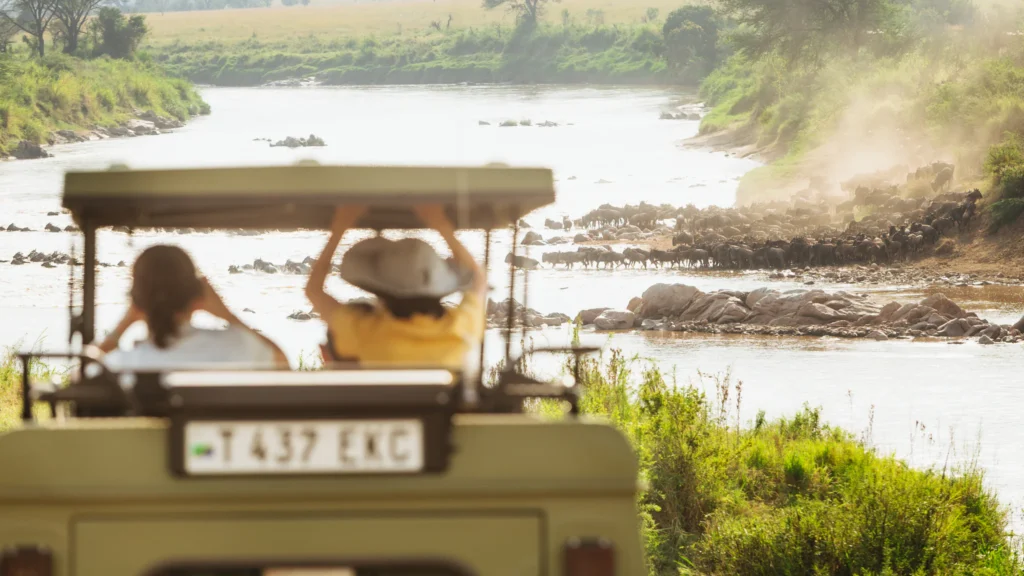
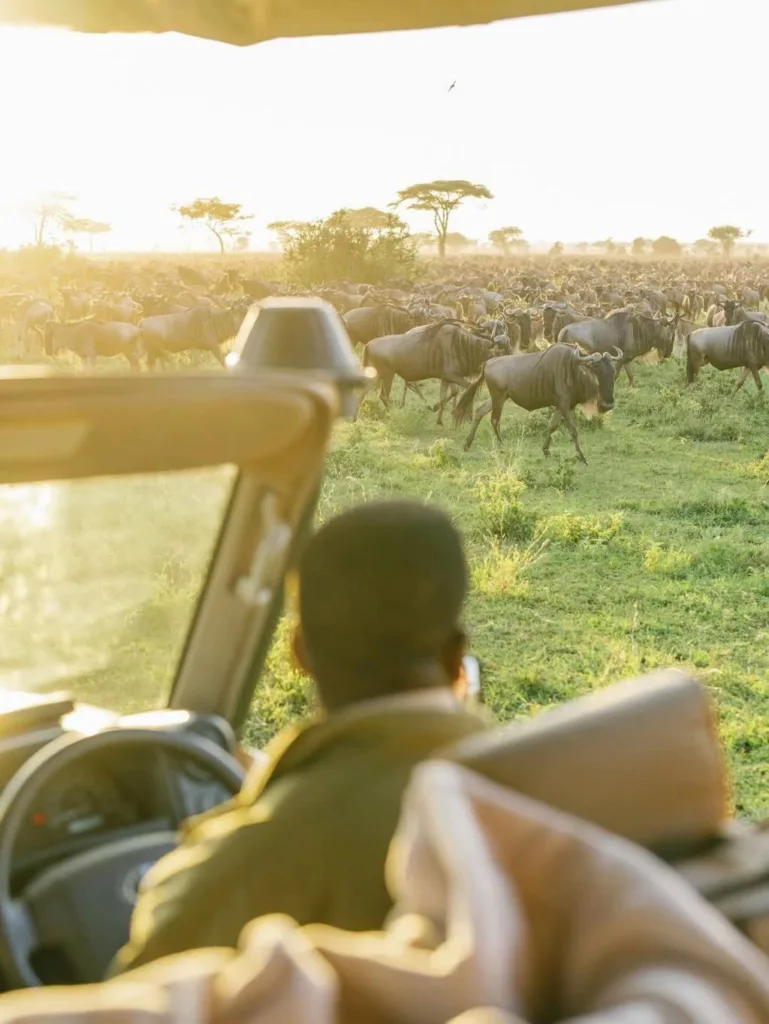
Day two is dedicated to Northern Serengeti, the Mara River, and the movements of the migrating wildebeest and zebra herds. You will leave your accommodation early, usually after breakfast or with a packed breakfast depending on the location of the herds.
The Mara River forms part of the natural boundary between Tanzania and Kenya. Wildebeest moving through the Serengeti ecosystem may cross the river in either direction as they search for fresh grazing and water.
Your guide will use recent sightings, radio communication, animal movement, vehicle activity, weather conditions, and personal knowledge of the area to decide where to begin. This is not a fixed-route game drive.
A crossing may begin suddenly, but the buildup can take hours. Thousands of wildebeest may approach the river, retreat, change direction, or move to another crossing point before one animal finally enters the water.
During quieter periods, your guide will also search for lions, leopards, cheetahs, elephants, giraffes, hippos, crocodiles, hyenas, topi, eland, and other animals living in Northern Serengeti.
Your Tanzania Safari Experience guide will explain more than what you can see from the vehicle. As a Tanzanian guide who understands the relationship between the wildlife, land, seasons, and local environment, they will help you understand why the herds move, how predators respond, and what influences crossing behavior.
You will normally carry a picnic lunch so that you can remain in the wildlife area instead of returning to camp in the middle of the day. This gives your guide the flexibility to stay near the river when conditions look promising.
The day ends with a game drive back to your accommodation. Wildlife can remain active during the late afternoon, and the lower light is usually better for photography than the harsh light around midday.
Optional Balloon Safari: USD 550 per Person
Travelers who can stretch their budget may add a Northern Serengeti balloon safari for approximately USD 550 per person. The balloon experience can be included in the quotation as an optional activity.
You will be collected before sunrise and transferred to the launch site. After a safety briefing, the balloon rises above the plains as the morning light begins to reveal the landscape.
Depending on the launch site, wind direction, and operating conditions, the flight may pass near sections of the Mara River and above areas used by migrating wildebeest. Flight routes cannot be guaranteed because balloons travel with the wind.
From the air, you may see long columns of wildebeest, scattered zebra herds, river channels, hippos, elephants, giraffes, and predators moving through the grass. Seeing the scale of the migration from above gives a perspective that is impossible to get from a vehicle.
There is also a chance of seeing wildebeest approaching or crossing the river during the balloon flight. However, this is a matter of timing and luck, not something any operator can promise.
After landing, balloon passengers normally enjoy a bush breakfast before meeting their safari guide and continuing the full-day game drive.
Best Choice
Choose the balloon safari when aerial photography and seeing the overall scale of the migration matter to you. Skip it when your main priority is spending every available morning hour tracking possible river crossings from the ground.
Are River Crossings Guaranteed?
No safari company, camp, guide, or travel agent can guarantee a Mara River crossing. The herds are wild, their movements are controlled by natural conditions, and even guides working in the same area every day cannot know exactly when the animals will enter the river.
Be cautious when an itinerary claims that you will definitely see a crossing. That is marketing, not honest safari planning.
A good guide can improve your chances by monitoring herd movements, speaking with other guides, checking several crossing points, and positioning the vehicle carefully.
However, even the best guide cannot force animals to approach the river. A successful migration safari should therefore offer more than one possible highlight.
Northern Serengeti also provides excellent opportunities to see lions, cheetahs, leopards, hyenas, elephants, giraffes, hippos, crocodiles, and large plains-game herds.
The correct expectation is not, “I am paying to see a guaranteed crossing.” It is, “I am visiting the right area during the right season with an experienced guide who will give me the strongest realistic chance.”
Morning, Midday, and Evening in Northern Serengeti
Morning is usually best for predator activity, cooler temperatures, softer photography light, and checking early movement near the Mara River. Midday can be hot and visually harsh, but crossings may still happen. Evening brings better light again, although game drives must finish according to park operating rules.
| Time of Day |
Wildlife Activity |
Photography |
Temperature |
Practical Reality |
| Early morning |
Predators active, herds beginning to move |
Soft light and long shadows |
Cool |
Best time to leave camp |
| Late morning |
Herds may gather near crossing points |
Stronger light |
Warming |
Good time to monitor the river |
| Midday |
Many predators rest |
Harsh light |
Warm or hot |
Crossings can still begin |
| Late afternoon |
Wildlife activity increases |
Warm, softer light |
Cooling |
Good for predators and landscapes |
| Evening |
Animals remain active |
Limited by fading light |
Cool |
Vehicles must return before park closure |
Travelers sometimes assume that wildlife activity stops at midday. This is not correct.
Predators may rest, but migration movement can continue. Wildebeest do not wait for ideal photography light before crossing.
When the herds are close to the river, it can be sensible to remain in the area with a picnic lunch. Returning to camp may mean missing sudden activity.
Your guide should not spend the entire day waiting beside an empty river without evidence that the herds are nearby. A better approach is to balance river monitoring with wider wildlife exploration.